Case Study 02
Design, Business & Leadership
Building, Scaling, and Leading CAS Design and Research
Overview
When I joined the UX team as a designer, the product division was just being created. CAS had just hired a VP of Product and product maturation was low. When I became Head of Product Design and Research, both the team and CAS were on the verge of the biggest changes in their respective histories.
The company was moving toward expanding product content offerings to life sciences, and the editorial tools that directly sourced our products with data were over 40 years old. The UX team prior to my joining had experienced culture issues which caused an exodus of all but two team members. It was a moment of challenge, and opportunity.
Impact
- Prioritized design and research as fundamental principles and catalysts for product innovation.
- Expanded the design and research teams to 8 personnel, reaching new product verticals and internal tools. Challenged the team to overhaul existing product experiences with a simplified, results-driven vision.
- Established cross-functional five-year growth strategies and annual department objectives and goals.
- Collaborated with the technology division to create a design system for internal and external use, breaking down silos and establishing a shared language across products, components, and features.
- Oversaw the design and launch of four external products, a complete overhaul of internal curation tools, and the deployment of agentic AI to optimize the user experience.
- Developed customer satisfaction metrics including CSAT and NPS, and prioritized WCAG 2.2 Level AA accessibility compliance across all products and services.
Culture:
Establishing Leadership Style
I lean toward a straightforward approach. Feedback is critical and bidirectional. Without feedback we cannot improve. The key to good feedback is making sure it is focused and constructive, whether for designs, research strategies, or intrapersonal relationships.
I established a cadence of regular meetings to reestablish team dynamics. All designers were equipped with the latest hardware and grouped at a shared pod when we returned to the office, enabling continual collaboration on cross-product consistency and functionality. We also began migrating our tools from Adobe Creative Cloud to Figma.
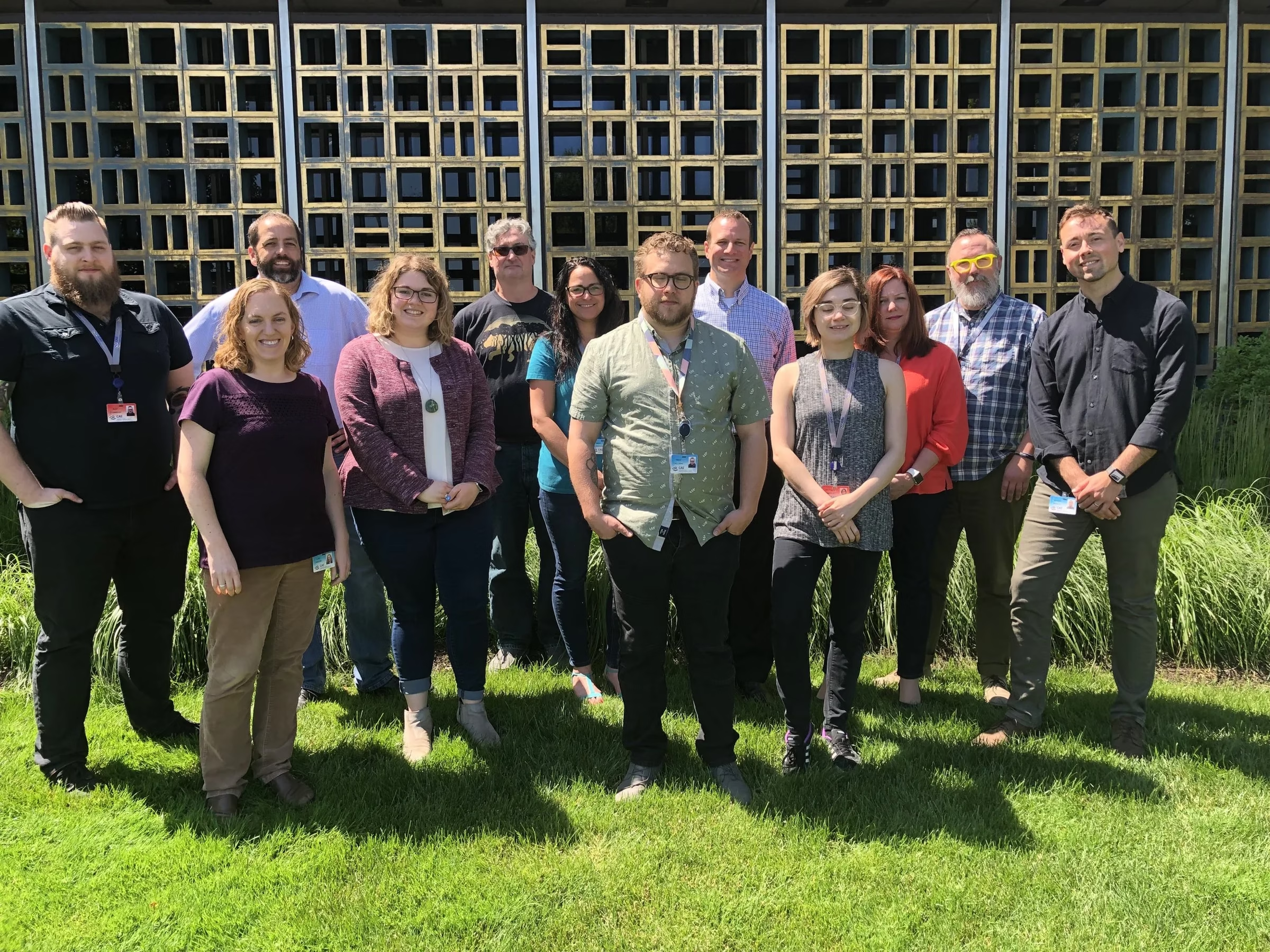
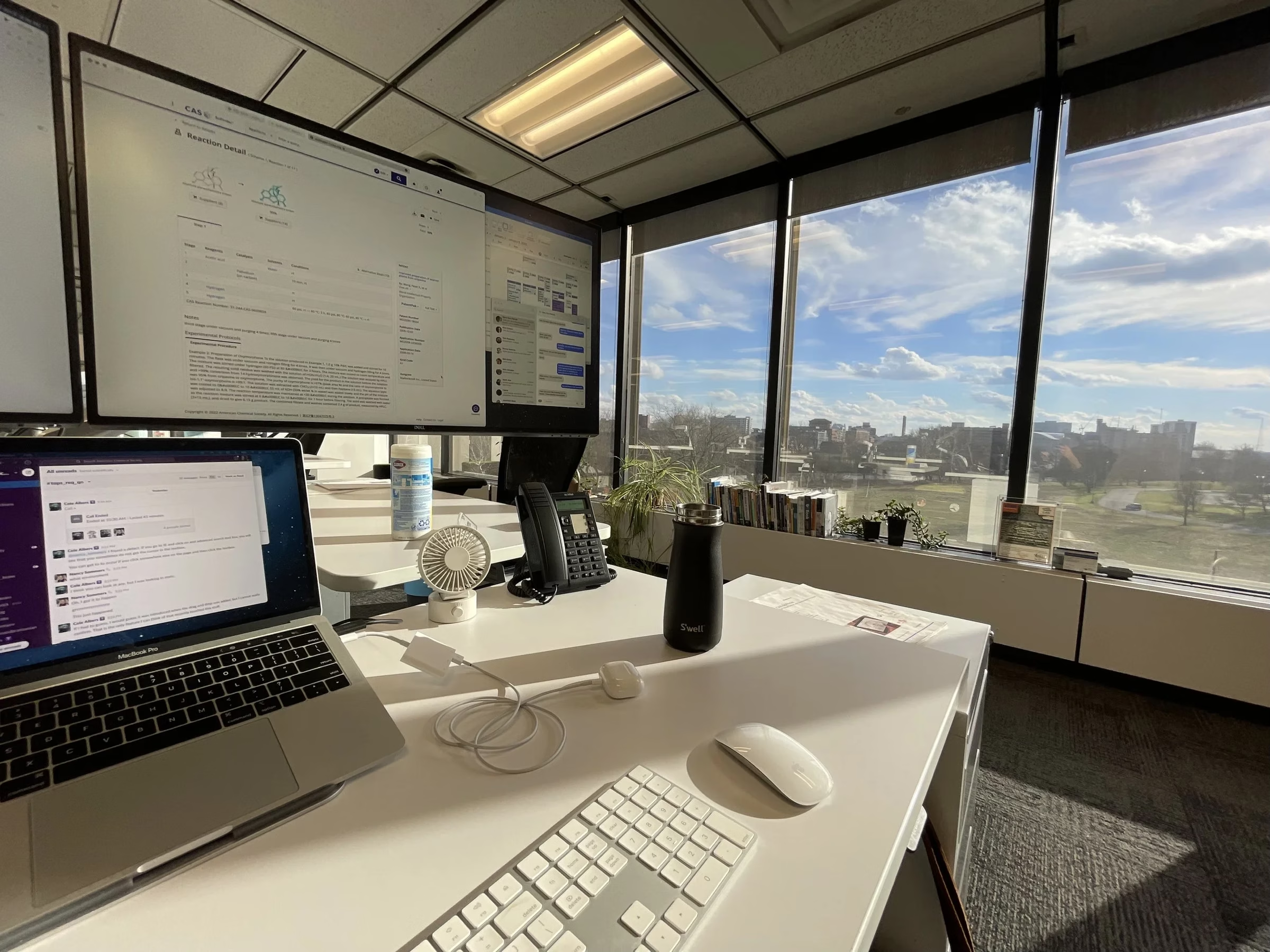
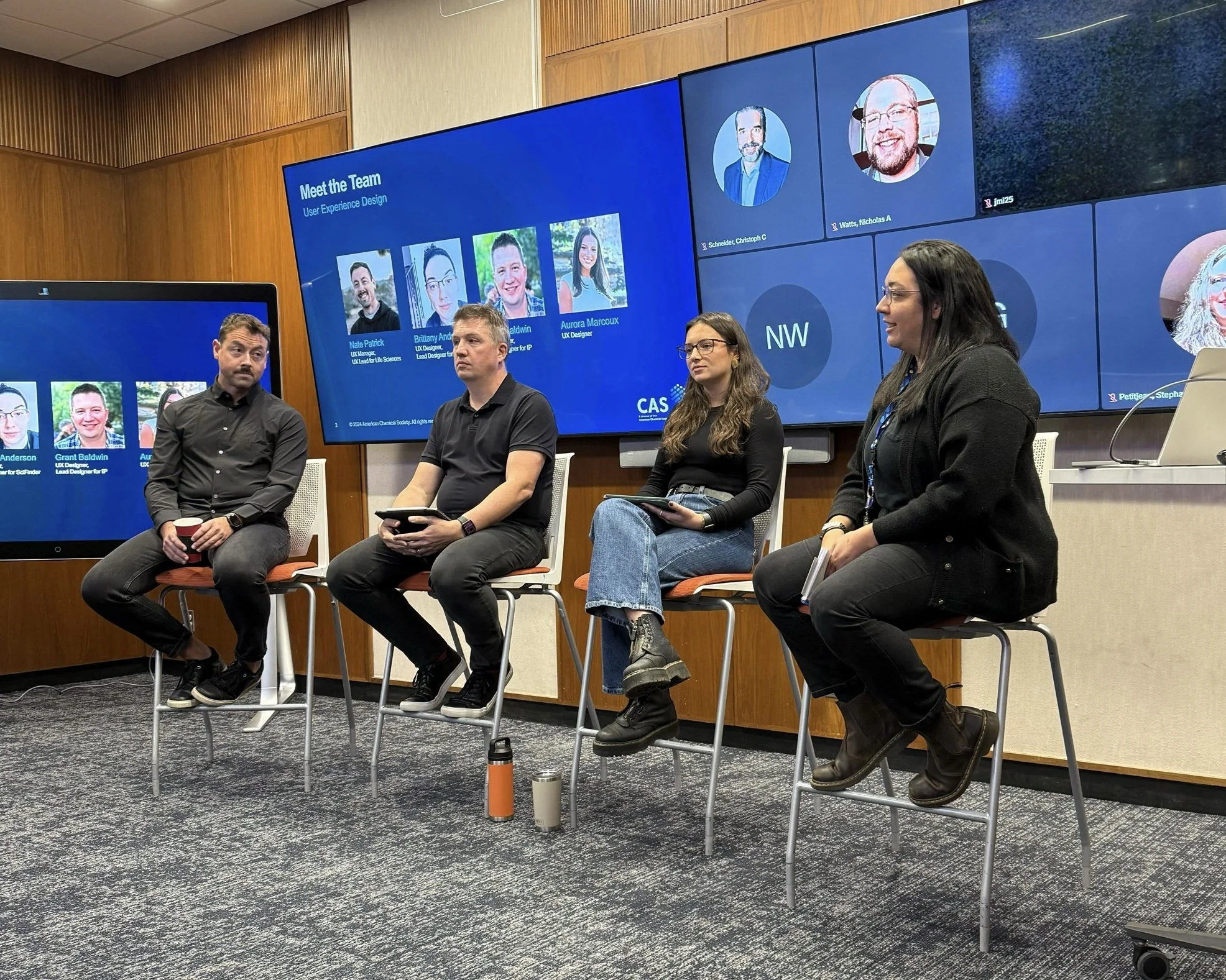
The CAS design and research team (left) and one of the design workspaces (right)
Culture:
Rebuilding a Team
My goal was to recruit and retain world-class talent. During that time, I interviewed 39 candidates, welcomed 5 designers, hired two satellite research agencies (one focused on operational research for existing products, another to spearhead innovation through generative exploration), and a coordinator to manage the inner workings of the department.
Regular team cadence
- "Week ahead" meetings on Monday mornings to align on priorities.
- Wednesday 1:1 meetings with a cadence defined by direct reports (minimum once per month).
- Friday Roundtable meetings where all team members present challenges, report on research findings, and present work to peers. Always scheduled before lunch for team building.
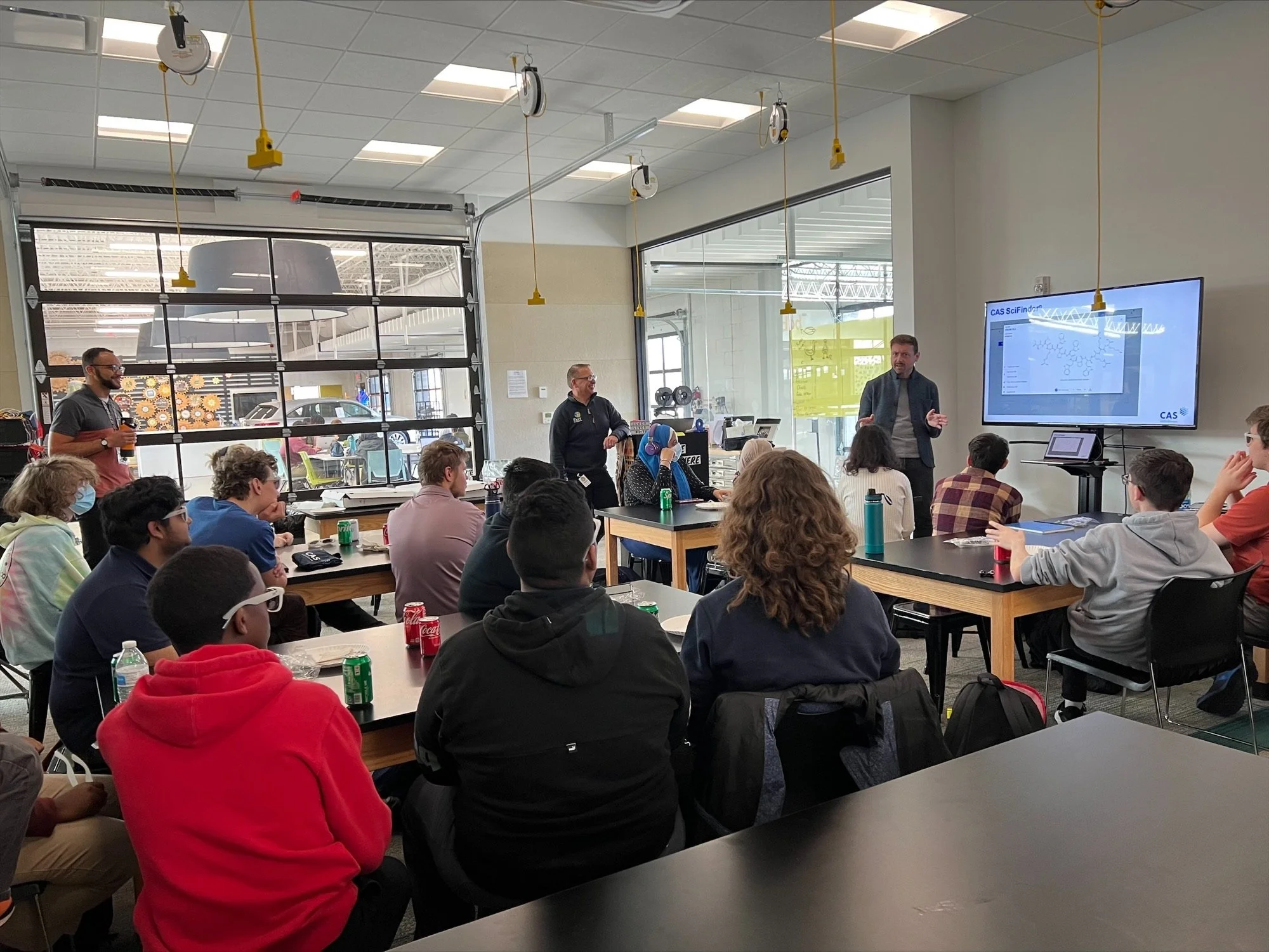
One of many team and cross-functional presentations
Vision:
Less is More
CAS data was structured in an old-school command line interface, requiring users of specific personas to know the proper query language to get good answers. Other products sequestered results into query types. Both were acceptable paradigms, but less so for multimillion dollar software in the early 2020s.
I challenged the team to think about the business value of renewals, how to account for younger demographics of users entering the sciences, and how to best integrate emerging AI capabilities after watching ChatGPT and Claude make their debut. After a structured brainstorming session, we rallied around a vision of simplified search paradigms and results listings, with a stretch goal of the agentic experience becoming the forefront of our product.
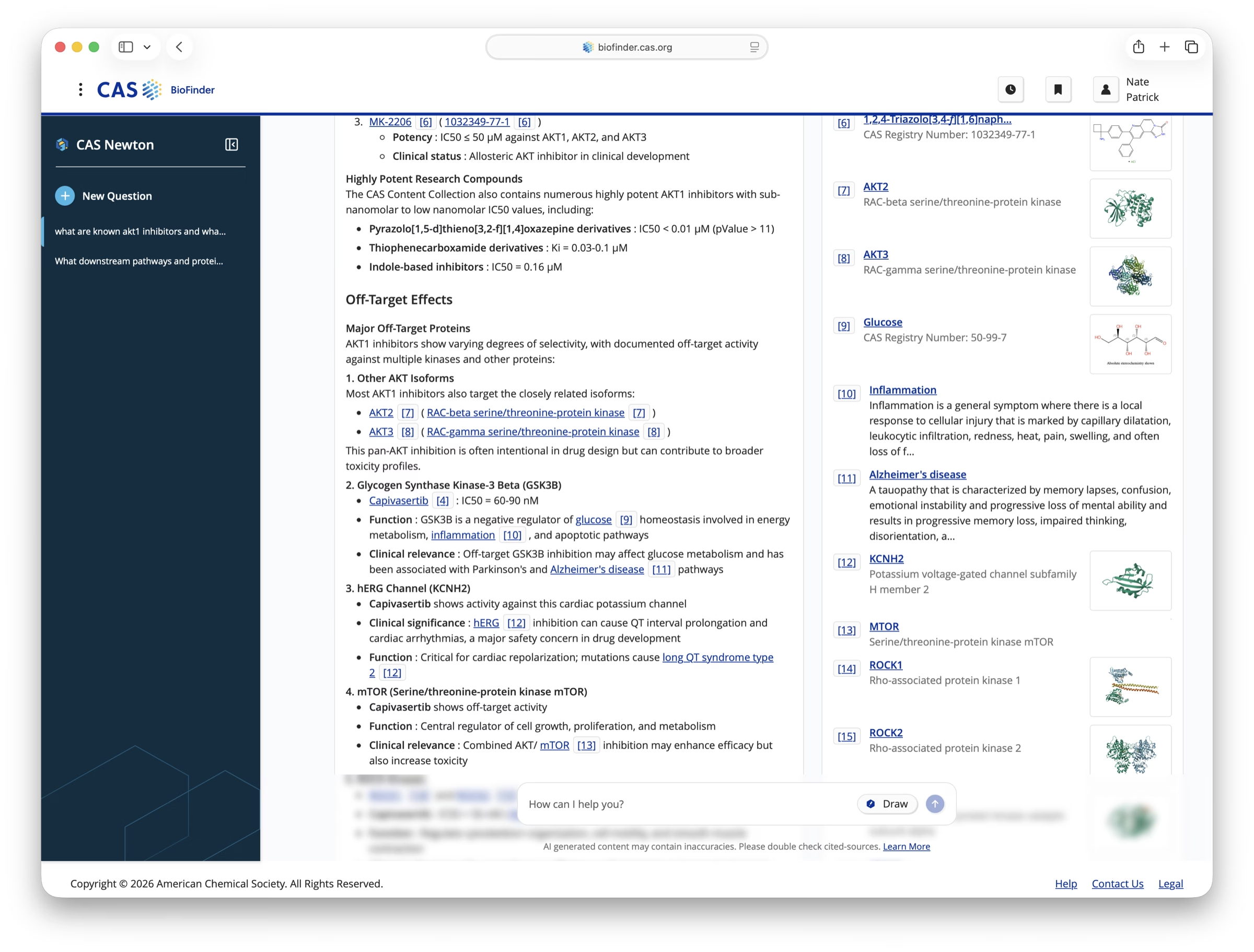
We found that 82% of users wanted simplified platform results, but were skeptical of the trustworthiness of AI-generated answers. The designers and I agreed that answers augmented by citations and sources were the best way to earn user trust in the outputs.
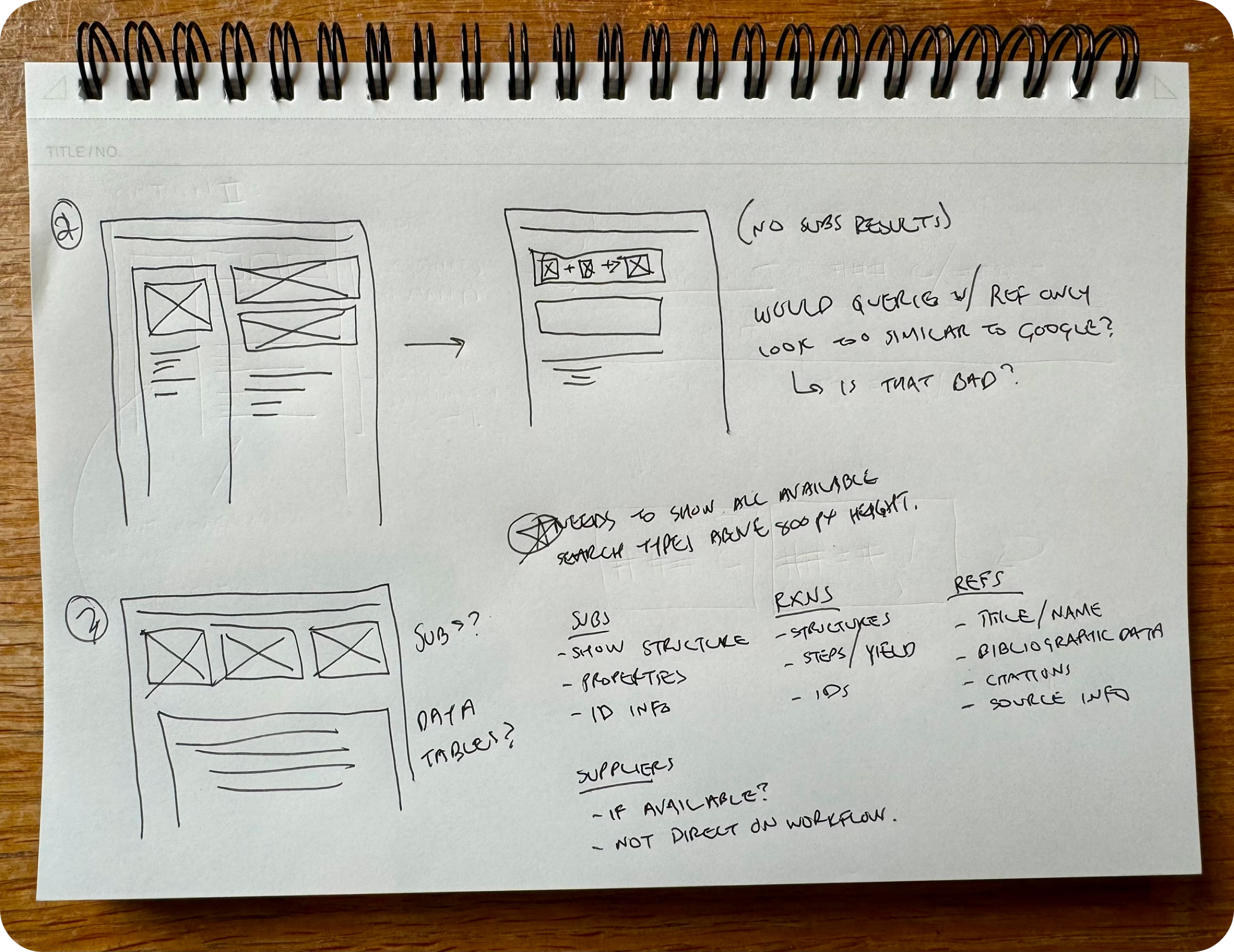
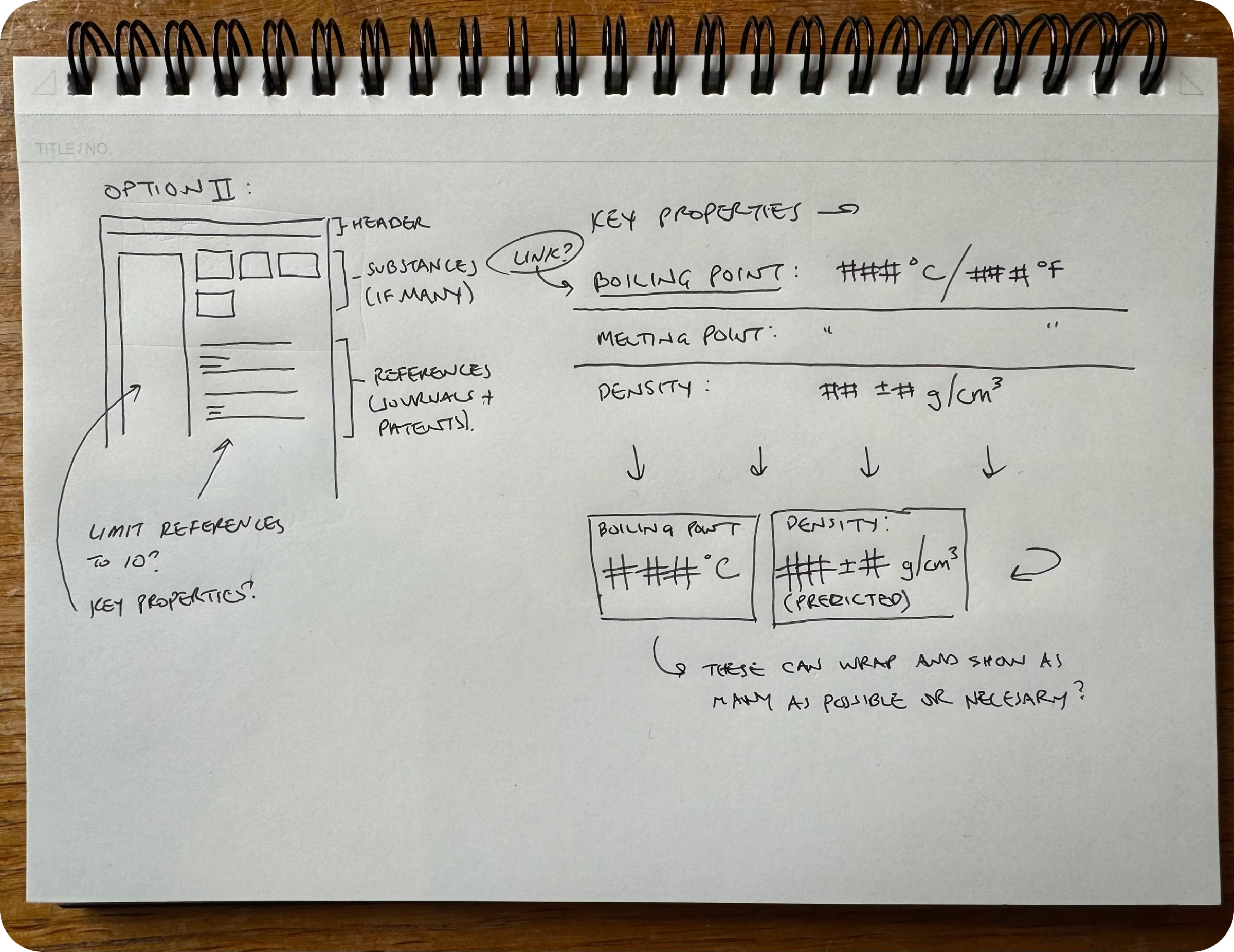
Early sketches exploring the unified search bar and simplified results vision
Vision:
Outcomes
One by one, each product moved toward a unified search bar, accounting for all content types on a single page and giving users a summary of what data was relevant to their questions. This extended into AI summaries for intellectual property data, freedom-to-operate queries, drug intelligence, and biomarker data across the top three product verticals.
The simplification was first implemented in CAS SciFinder, our most prevalent platform focused on chemistry data. Aggregated answers saw a substantial increase in interaction with multiple content types, leading to increased renewals and revenue for the 2025 fiscal year.
Answer summarization was critical to the value increase. When users asked "what is the boiling point of [a substance]," the interface returned the exact measurement and provided evidence from where that answer was sourced. The strategy was to inform; users learned to trust thanks to the ability to verify answers in real time.
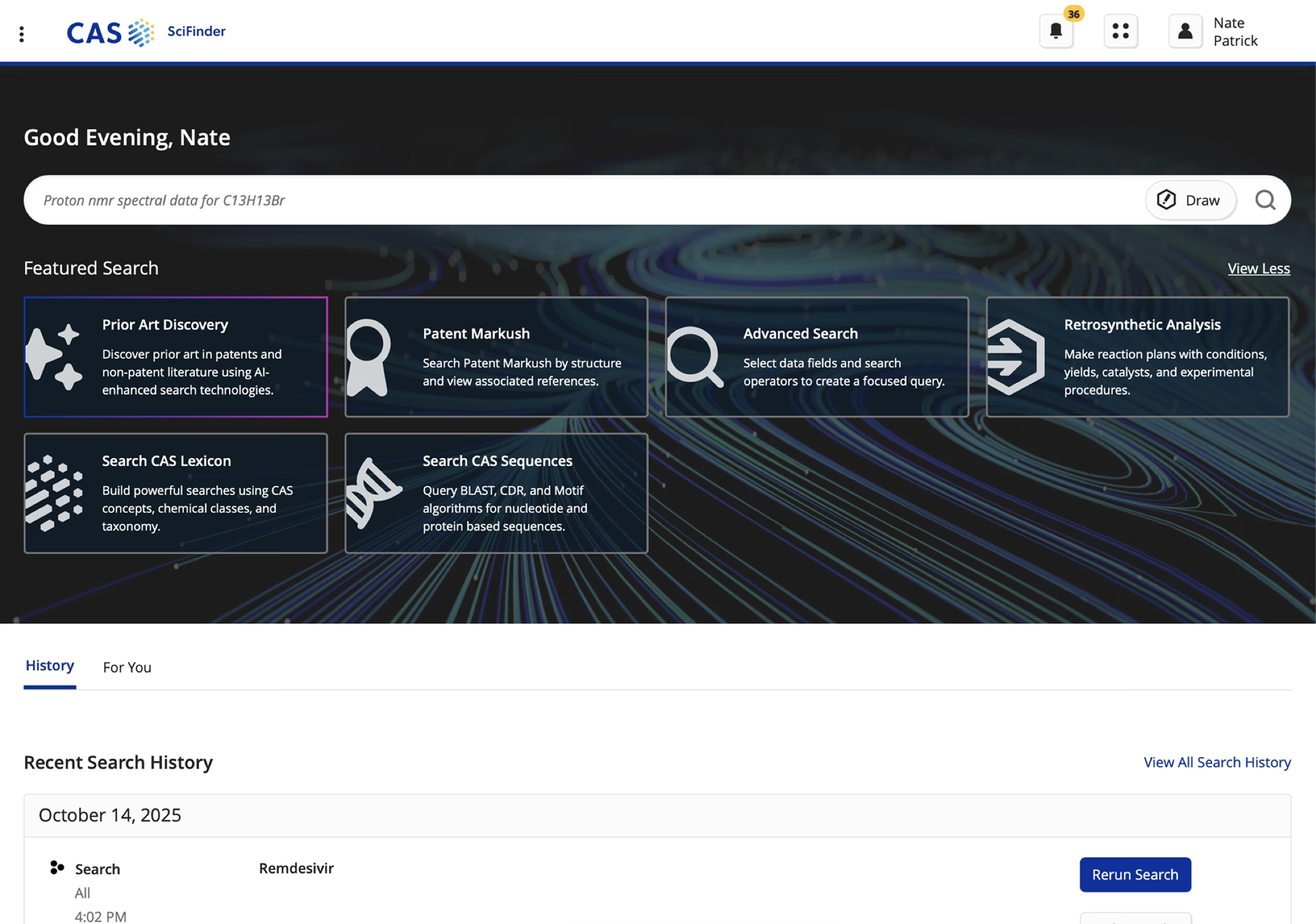
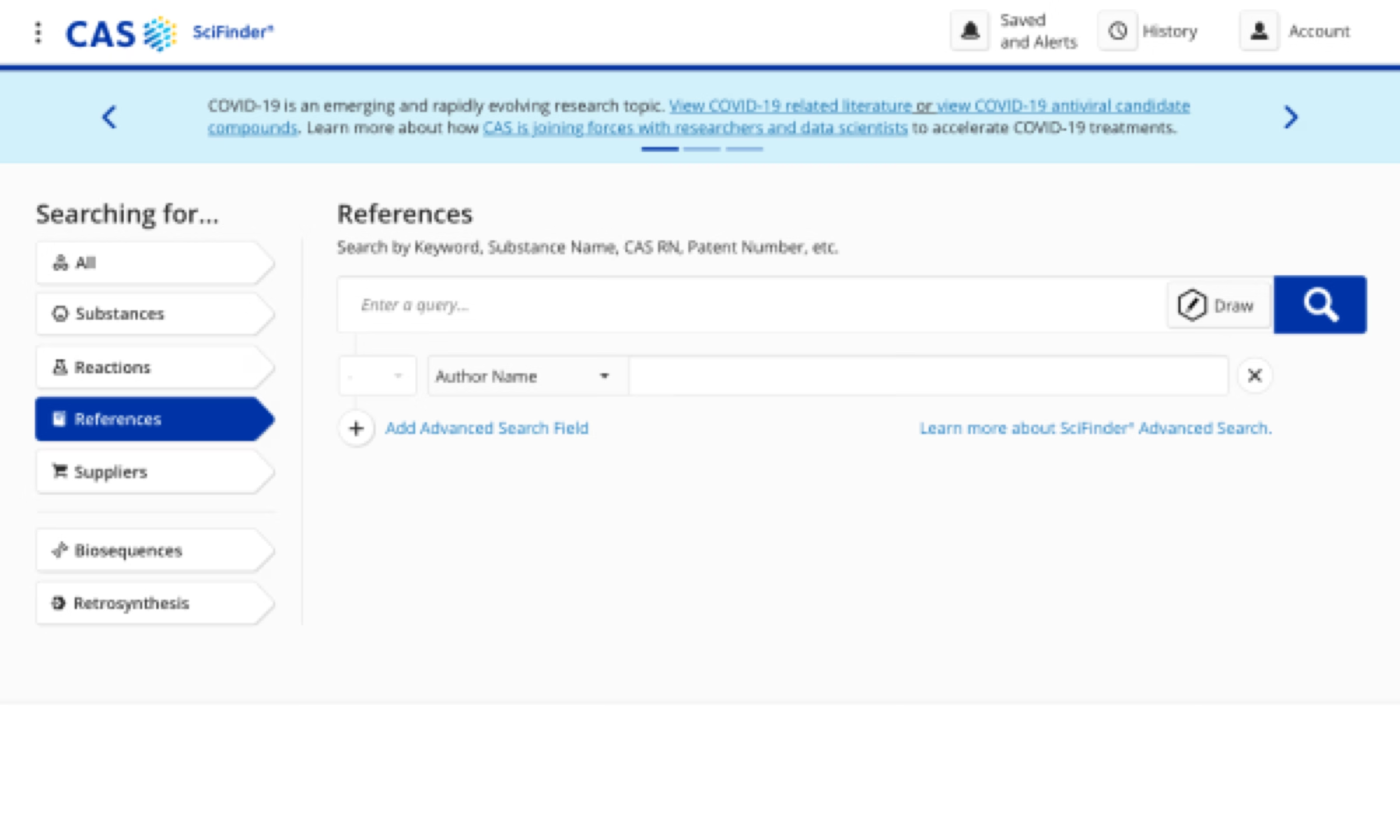 CAS SciFinder 2020
CAS SciFinder 2025
CAS SciFinder 2020
CAS SciFinder 2025
CAS SciFinder 2020 compared to CAS SciFinder with Augmented Value Driver Features and Design
+503%
Increase in usage for value drivers: CAS Lexicon, Retrosynthesis, and sequence searching
+28%
Increase in result content: substances, reactions, references, and patents
2 → 8
Design and research team headcount under my leadership
4
External products launched, plus full internal tool overhaul
Efficiency:
Research Optimization
Formal discovery research was intermittent in some areas and completely absent in others when I took over. As a means to increase the research-driven roadmap, I asked designers to partner with the research team and product managers to have at least one study running at all times. Research candidates are recruited via in-product surveys, a first for us thanks to the integration of Sprig.
Thanks to this effort, we expanded the research pool 38% in the first year and have maintained a constant landscape of research across various topics for the past three years.
Efficiency:
Design Optimization
Migrating the team to Figma proved to be a large morale boost. Great designers deserve great tools. Collaboration with product managers and analysts increased, allowing for more focused feedback on feature inclusions. Feature design cadence was dictated by product teams, but I removed the company's bad habit of asking for sketches before requirements or scope were defined.
Slotting designers into two-week sprints proved to be an effective time box to prevent analysis paralysis and excessive iteration. The design system dramatically improved development cycle times. Developers and designers spoke the same language, and engineering was encouraged to reuse existing components.
| Individual Contributor | Head of Design & Research | |||||||
|---|---|---|---|---|---|---|---|---|
| Category | 2018 | 2019 | 2020 | 2021 | 2022 | 2023 | 2024 | 2025 |
| Strategies | ||||||||
| Written strategy | ||||||||
| UX roadmap | ||||||||
| 5-year growth plan | ||||||||
| Persona development | ||||||||
| Operations | ||||||||
| Biannual usability heuristics | ||||||||
| Annual accessibility audits | ||||||||
| Design review process | ||||||||
| Unified design standards | ||||||||
| Design showcase & readouts | ||||||||
| Software development process | ||||||||
| Training | ||||||||
| Company training | ||||||||
| Design craft | ||||||||
| Developer fluency | ||||||||
| Accessibility | ||||||||
UX maturation matrix: a living document tracking team strategy, operations, and training from 2018 to present
Efficiency:
Expansion of Capabilities
I focused on ensuring the division progressed to be on par with best-in-class organizations. Goals became dynamic, SMART, and attainable, making it easier to track performance against OKRs throughout the year. Operations grew to increase exposure for designers and augment their ability to speak to design choices and translate them into business value.
This included crafting annual heuristics, annual VPAT updates to provide legal with documentation for inquiring customers, and cross-functional five-year growth strategies aligned to the company roadmap.
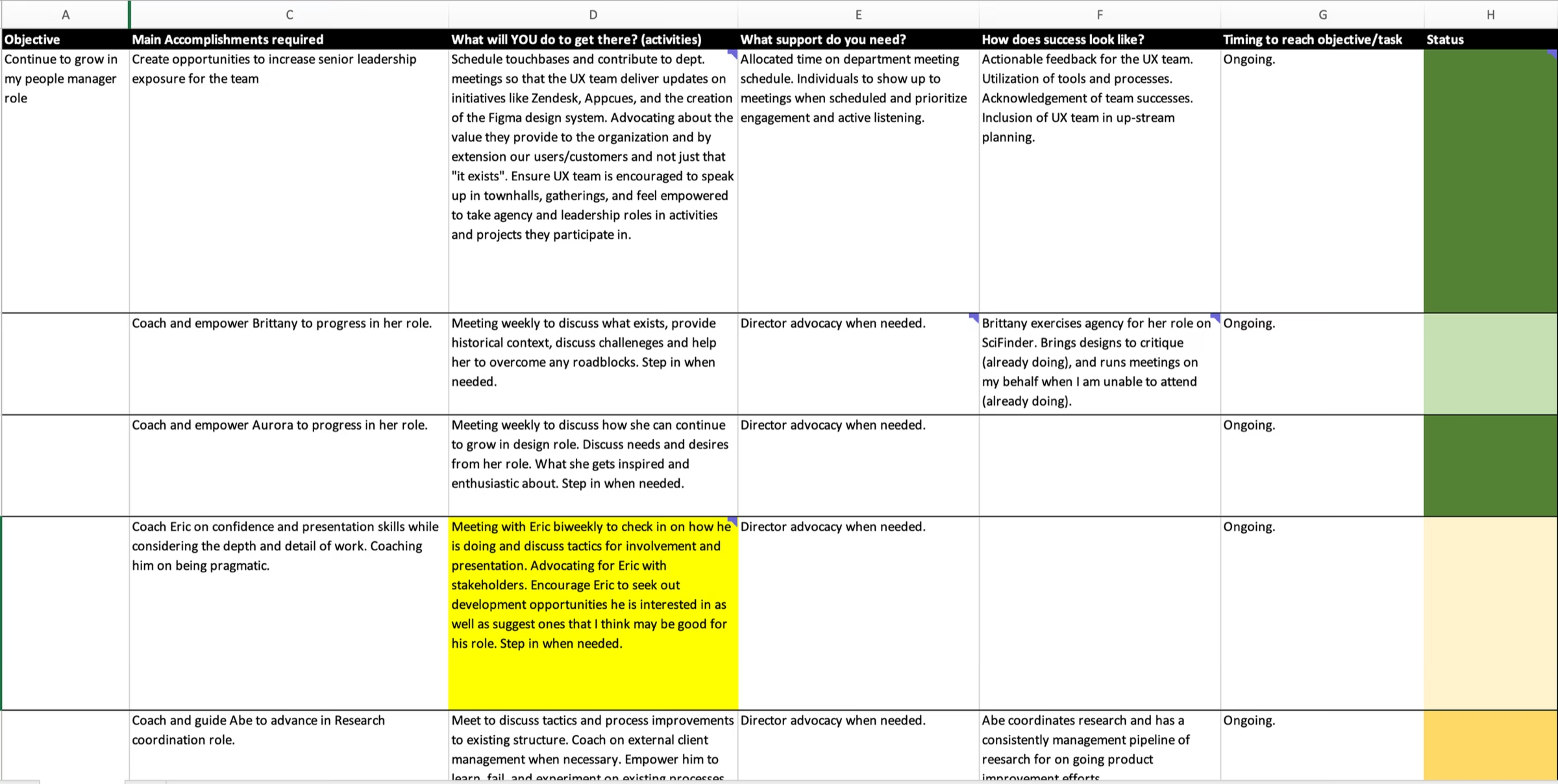
Team growth and coaching objectives framework, reviewed quarterly
Growth
My philosophy is to coach and work with designers and researchers to empower them to work anywhere. The best culture exists when people want to stay. Throughout my time as Head of Design and Research, I have made sure to invest in careers by listening to each person's desires and goals for growth.
I developed a development matrix that each team member is responsible for. These living documents give clarity to the direction each employee wants to take and define what skills they want to build. Progress is flagged as green (on track), yellow (requires adjustment), or red (requires concrete feedback and a clear plan).
To date, employee churn has been limited to one termination and one designer who found a great new opportunity. I'm proud to see people on my team achieve their goals.
A framework I use to guide growth conversations: managing drives short-term wins, leading compounds over time — the goal is both
Testimonials
"Nate leads with confidence, conviction, and humility, empowering teams through efficient communication and clear direction. He brings exceptional expertise and cross-functional support, driving alignment and impact to every project he is involved in."
Senior Solutions Marketing Manager, CAS"I really appreciate the considerate way Nate leads our design team. He treats us all as equals, and gives valuable feedback and support."
Lead Designer of CAS BioFinder"Nate has been a fantastic cross-functional partner. He helped me quickly understand the 'why' behind our work and shared valuable insights into our customers' needs."
Lead Designer, Retrosynthesis and Internal ToolsReflection
Leading design and research at CAS has been the most complex and rewarding work of my career. The challenge isn't just making great products. It's making great products with a team that trusts each other, holds each other to a high standard, and genuinely cares about the scientists on the other end of everything we build.
What I'm most proud of isn't any single product or metric. It's the culture. It's watching designers grow into leaders, watching researchers become strategic partners, and watching a fragmented group become a team people are proud to be part of.