Case Study 04
Plas-Tanks Industries
Replacing a 20-year Excel quoting workflow with a guided SaaS configurator
Overview
Plas-Tanks Industries is an FRP (fiberglass reinforced plastic) tank fabricator based in Fairfield, Ohio, producing custom chemical-storage vessels for industrial and municipal clients. Their sales quoting process ran through JobCalc, a macro-driven Excel workbook built in 2003 and supplemented by a separate pricing and materials spreadsheet.
I was brought in to replace this fragmented legacy system with a guided configurator that encodes engineering expertise as built-in guardrails, unifies the quoting workflow, and produces a structured digital handoff from sales to the manufacturing floor.
Challenge
Four interlocking problems made the status quo untenable:
- Legacy fragmentation: two disconnected Excel files (engineering configuration and pricing/materials/labor) with no unified workflow connecting them. Every quote required expert intuition just to navigate between them.
- Knowledge risk: the Head of Sales had been with the company 46 years and was approaching retirement. His institutional expertise, covering chemical compatibility, pricing intuition, and exception handling, couldn't be replicated through hiring, and new sales engineers struggled to onboard into a complicated tool and a highly technical domain at the same time.
- Versioning failures: spreadsheet version conflicts caused cost-estimation errors that directly impacted customer quotes and lost sales. Broken macros and out-of-sync files were routine hazards.
- Manual operations: project tracking ran through printed folders. No digital pipeline meant no priority visibility and no revenue forecasting for finance.
Research
I ran research in two phases: a stakeholder interview series, followed by direct observation of the JobCalc workflow in use.
Stakeholders interviewed
- COO / Head of Engineering
- Head of Sales (46 years' tenure)
- 2 Sales Engineers
Observation
I watched the sales engineers work through the macro-heavy Excel workflow live, entering RFI data across two disconnected workbooks, navigating macros, and reconciling outputs by hand. Quote generation was slow, error-prone, and entirely dependent on the operator's domain experience.
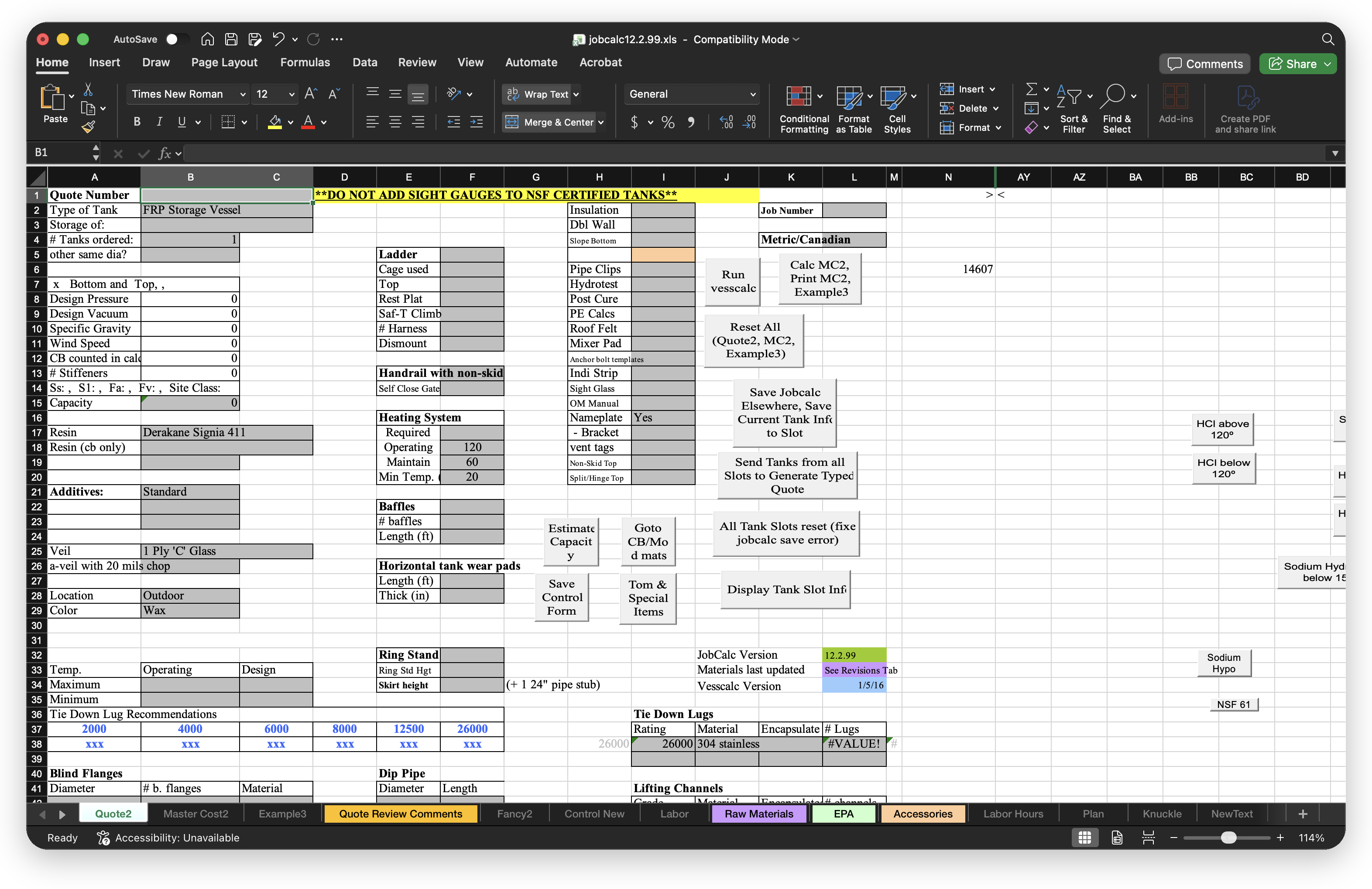
The old Excel version of JobCalc, before the redesign. Observation was critical for understanding workflows paramount to the company's manufacturing processes and revenue generation.
Key Findings
COO / Head of Engineering
Concerned about the inability to track, prioritize, or forecast work. Jobs were managed through printed folders, with no visibility into pipeline status or revenue projection.
Head of Sales
Forty-six years of institutional knowledge with no transfer mechanism. He couldn't maintain sales engineers with equivalent expertise, and needed the tool to encode his knowledge as built-in guardrails.
Sales Engineers
JobCalc required expert-level domain knowledge just to navigate. Onboarding new reps was slow and high-risk, and versioning issues had already caused pricing errors on real customer quotes.
Design & Build
I designed and built the FRP Tank Quoter solo, from blank repository to deployed application, in four days (April 20–23, 2026).
Legacy workflow vs. new pipeline
The clearest way to show the value of the new system was to put it side by side with what it replaced.
Before: two disconnected spreadsheets and a paper trail. After: one configurator with a digital handoff straight to manufacturing.
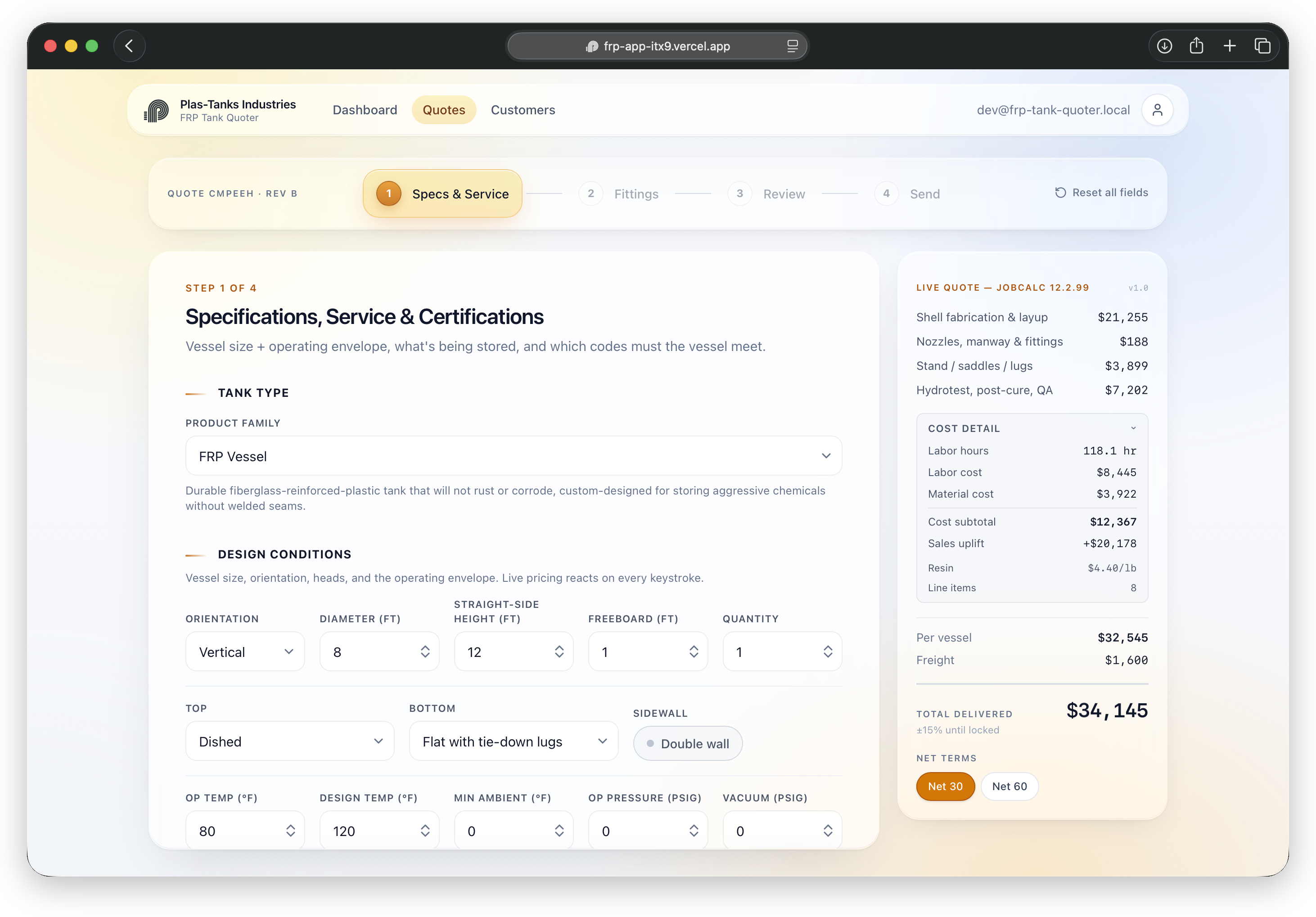
The configurator wizard
A 4-step guided flow walks a sales engineer from a blank quote to a structured engineering spec, validating inputs against the rules engine at every step.
Step 1: Specs & Service, Step 2: Fittings & Accessories, Step 3: Review, Step 4: Send
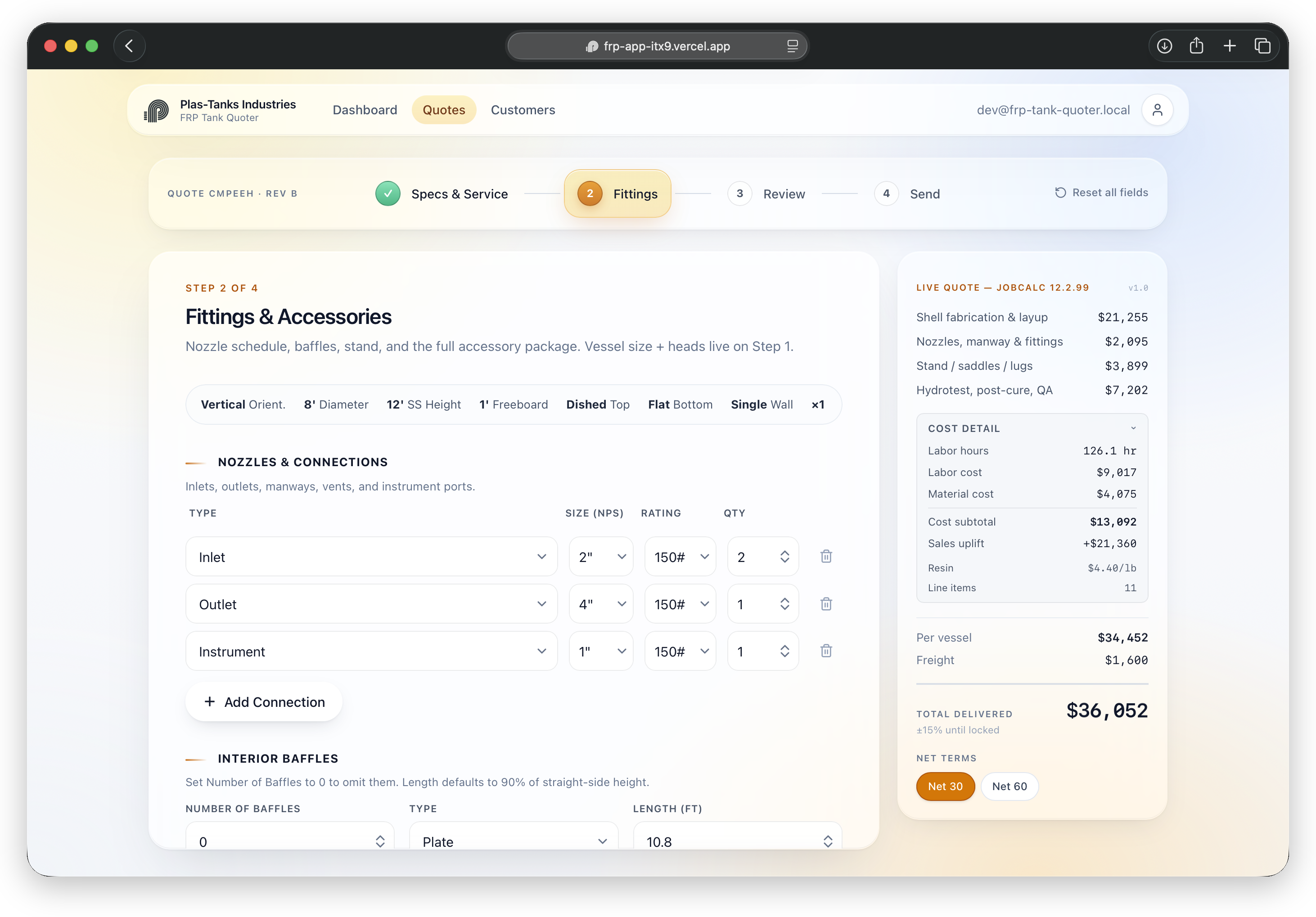
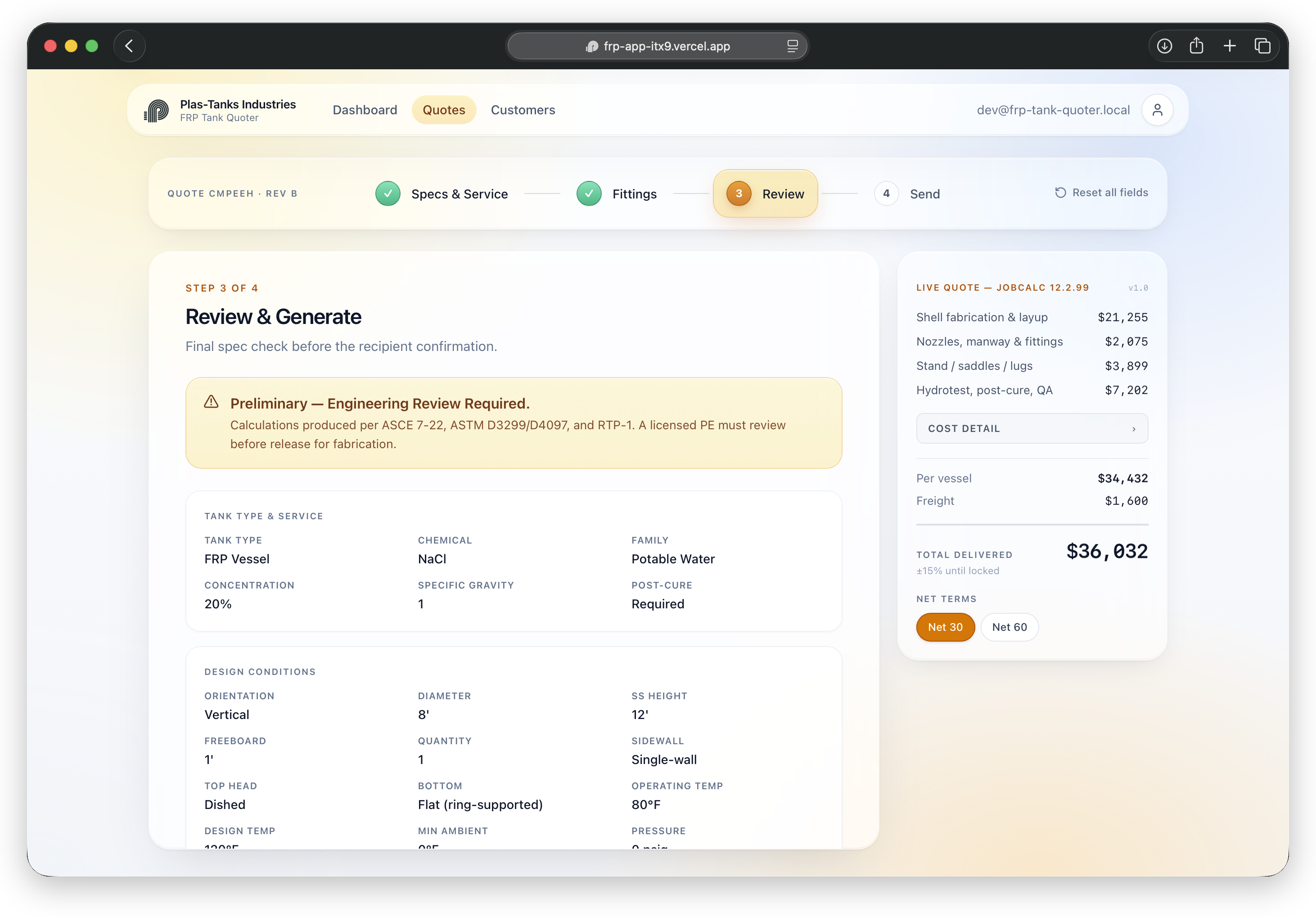
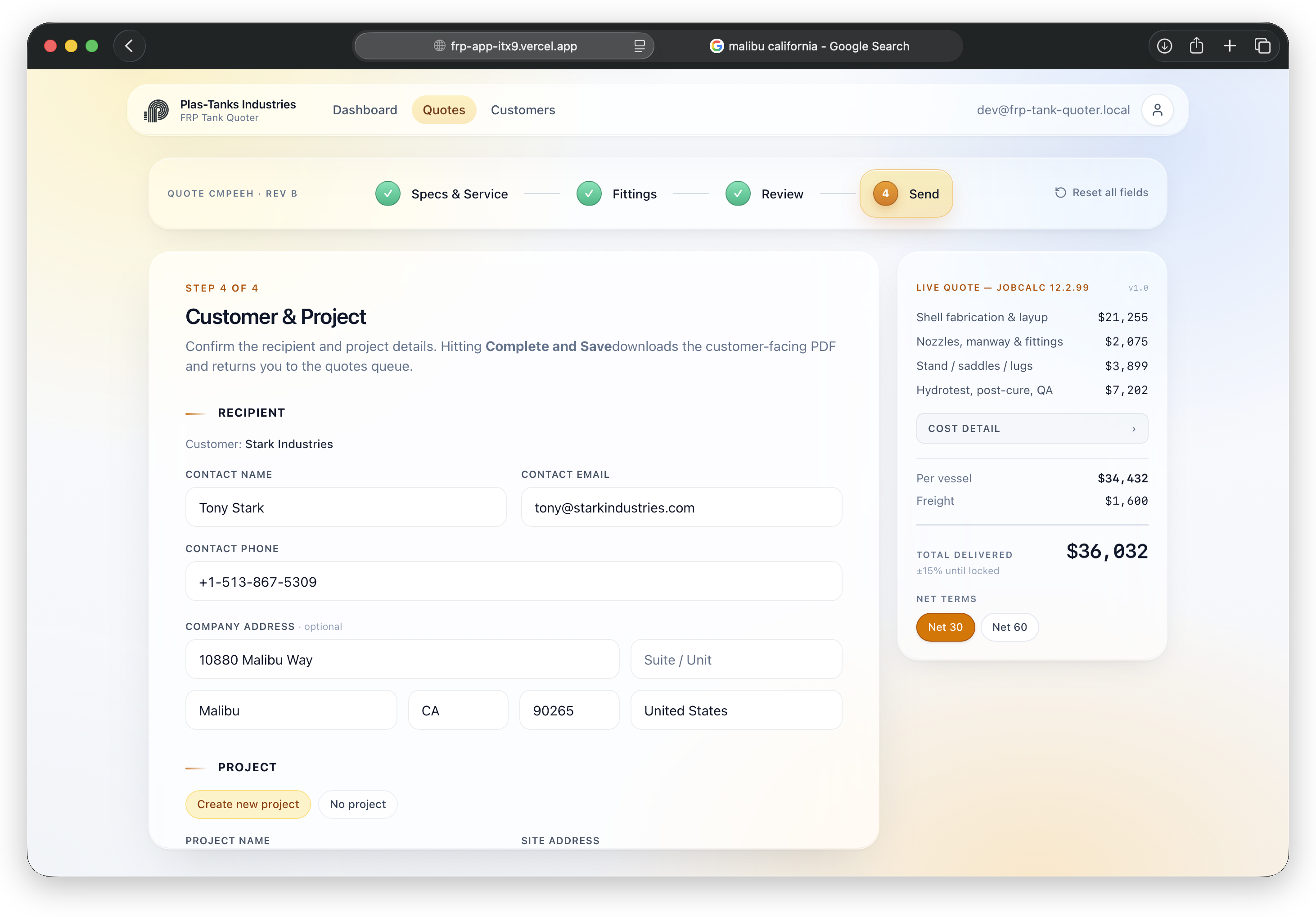
The full wizard: Specs & Service, Fittings & Accessories, Review & Generate, and Send, with the live pricing rail updating on every input
Live pricing rail
A persistent right-hand sidebar recalculates total delivered cost on every keystroke. It shows an itemized breakdown (shell fabrication and layup, nozzles, manway, and fittings, stand and saddles and lugs, finishing and seam work, hydrotest, post-cure, and QA) plus an expandable detail view for labor hours, material cost, and sales uplift. The rail is labeled "LIVE QUOTE — JOBCALC 12.2.99 v1.0," deliberately preserving the lineage of the legacy tool while showing what it became.
Rules engine
A chemical compatibility matrix built from the Ashland Derakane and Hetron resin lines, ASTM D3299/D4097/RTP-1 wall-thickness math, and ASCE 7-22 seismic and wind structural analysis encode what previously lived only in the Head of Sales's head as validated, programmatic guardrails.
Engineering JSON output
Quote completion emits a structured, versioned, machine-readable spec, replacing the email-and-PDF handoff from sales to engineering with a formal, auditable artifact suitable for direct use on the manufacturing floor. The same specification preloads AutoCAD with the vessel's geometry and fittings, giving engineering a drafting head start instead of a blank sheet and accelerating the handoff from quote to drawing.
Job status pipeline
Quotes move through draft, sent, and won/lost. Aggregating status across every quote gives finance a live revenue forecast, a capability that didn't exist before.
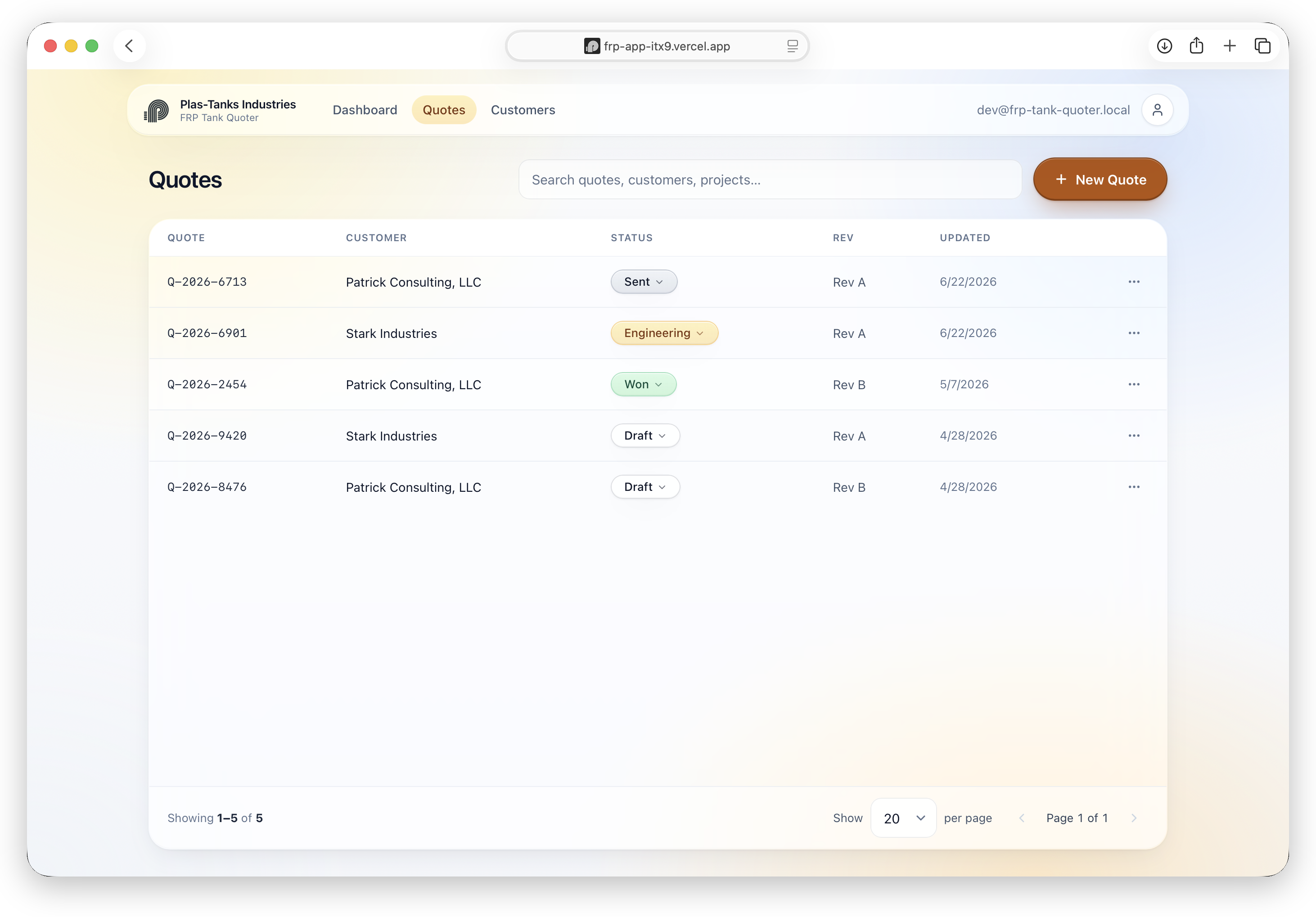
The job queue: every quote tracked by customer, status, and revision, the digital replacement for printed folders
Customer relationship management
Plas-Tanks had no CRM. Customer data lived in scattered contacts and email threads, with no system of record tying a company to its quotes, contacts, or history. The rebuild was an opportunity to port that data into the application and give sales a real mechanism to capture, expand, and manage customer relationships going forward: a quick form for one-off entries, and a bulk importer for migrating existing contact lists.
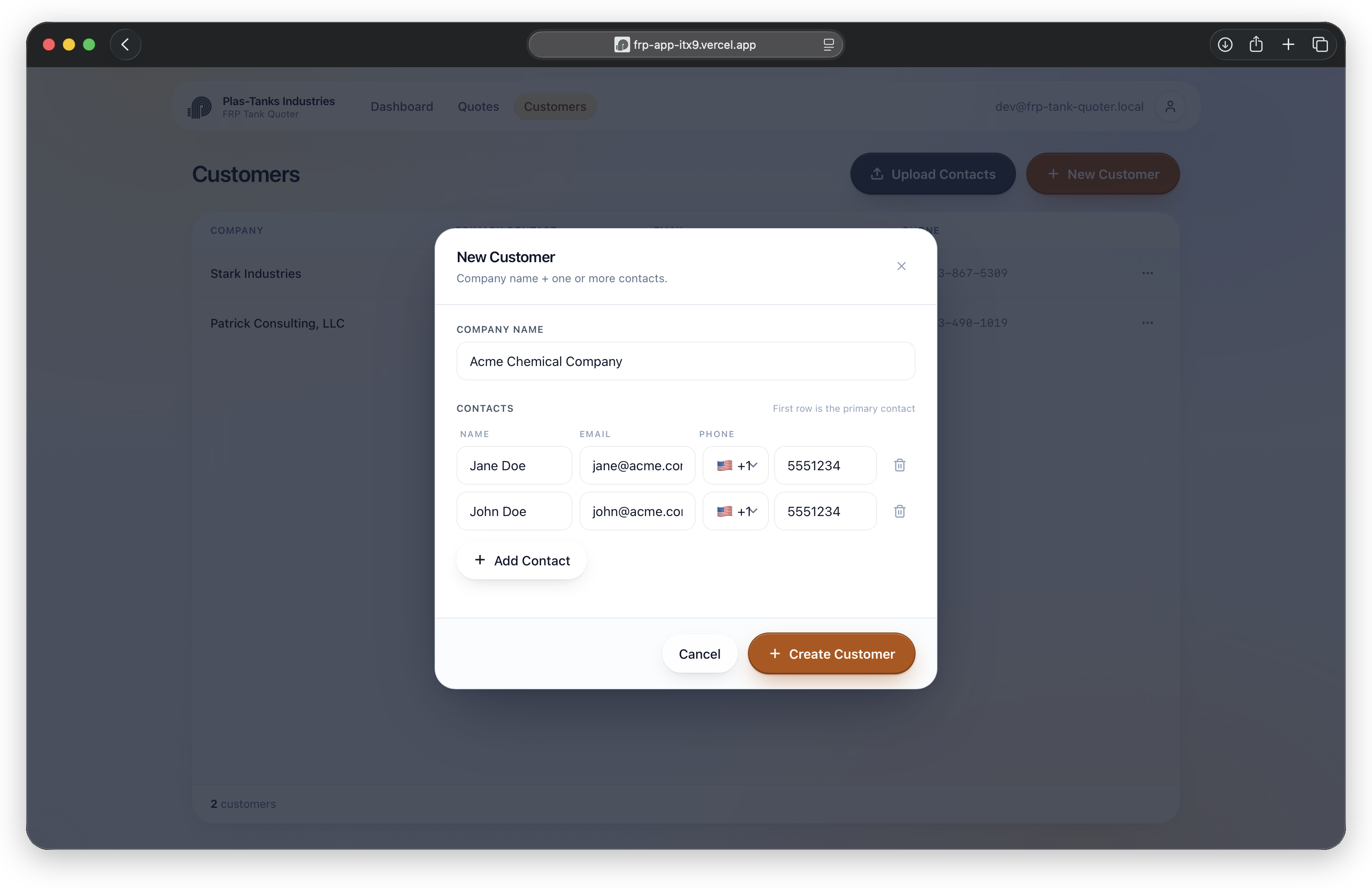
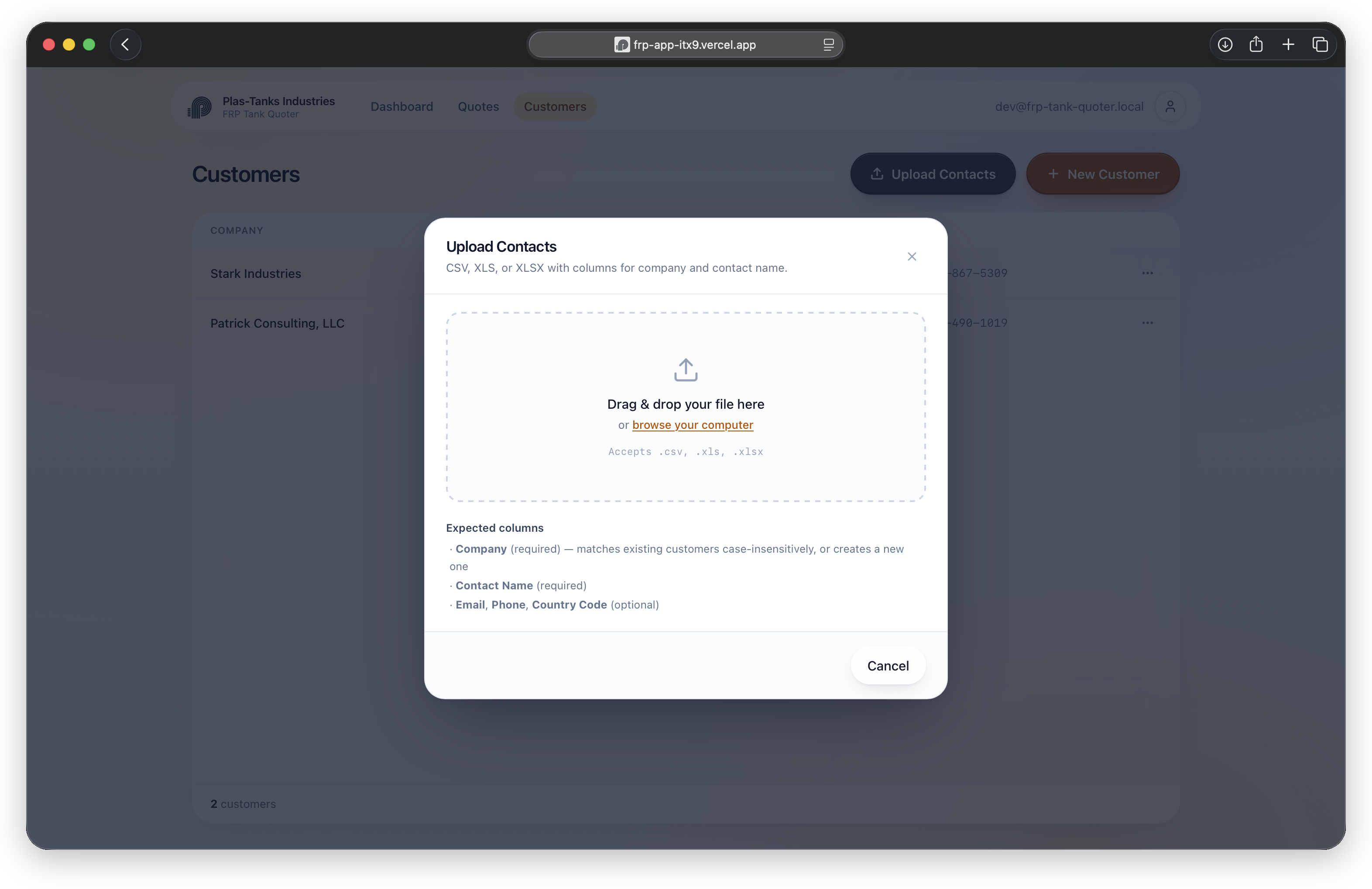
Closing the CRM gap: adding a company and contacts directly (left), or bulk-importing an existing contact list (right)
Outcomes
4 days
Blank repo to deployed application, April 20–23, 2026
4
Stakeholders interviewed across sales and engineering
The digital pipeline replaced printed-folder chaos with a trackable, prioritized job queue. Finance gained revenue forecasting for the first time. The rules engine encodes decades of sales expertise as guardrails accessible to any new hire from day one, and the engineering JSON output closes the information gap between the quote and the shop floor.
Reflection
I'm not a structural engineer, and before this project I couldn't have told you why one fiberglass resin holds up in a given chemical service while another fails outright. Most of the real work happened away from the keyboard. I sat with the Head of Sales, asked why a tank rated for 8,000 lbs needs a different tie-down lug than one rated for 26,000, and circled back to the same question three or four times before the actual rule underneath it surfaced. Forty-six years of that kind of judgment doesn't show up in a requirements doc on the first pass.
I'm prouder of what the tool quietly enforces than of how it looks. A sales engineer hired next month can open it and get the resin, the wall thickness, and the wind load right without calling anyone. That knowledge used to live in one person's head, and now it's a rule the software checks every time.
There's more to build. The engineering JSON output is a starting point, not a finish line. The next phase pushes that handoff further upstream into pre-fab planning, so a finished quote kicks off the production schedule instead of just describing it. I'd also like to bring the same kind of rigor to the shop floor itself, automating fabrication scheduling and plant-management workflows the way the quoting side already works, and give finance real revenue forecasting instead of just job-status counts: the kind of forward visibility that didn't exist when all of this lived in printed folders.